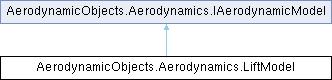
The model used to determine lift and lift induced drag acting on an object. More...
Public Member Functions | |
| AerodynamicLoad | GetAerodynamicLoad (AeroObject ao) |
| Compute the aerodynamic load acting on the aerodynamic object. More... | |
| Vector3 | GetLocalAerodynamicCentre () |
| void | UpdateDimensionValues (AeroObject ao) |
| Calculate and store any values which only depend on the object's dimensions. More... | |
| Vector3 | TransformBodyToLocal (Vector3 vector) |
| Rotates a vector by the quaternion rotation from the body frame of reference to the local frame of reference. More... | |
| Vector3 | TransformLocalToBody (Vector3 vector) |
| Rotates a vector by the quaternion rotation from the local frame of reference to the body frame of reference. More... | |
| AerodynamicLoad | GetAerodynamicLoad (AeroObject ao) |
| Compute the aerodynamic load acting on the aerodynamic object. More... | |
| void | UpdateDimensionValues (AeroObject ao) |
| Calculate and store any values which only depend on the object's dimensions. More... | |
Public Attributes | |
| float | angleOfAttack |
| float | alpha_0 |
| float | alphaForStall |
| float | effectiveAlpha |
| float | sinBeta |
| float | cosBeta |
| float | resolvedSpan |
| float | resolvedChord |
| float | thicknessCorrectionAggressiveness = 6f |
| Blending constant used in the thickness correction. More... | |
| float | stallAngleMin = 0.261799f |
| The starting angle for blending between pre and post stall. More... | |
| float | aerodynamicCentrePositionAtZeroAlpha = 0.25f |
| How far along the mean aerodynamic chord of the object the aerodynamic centre is positioned at zero angle of attack. More... | |
| float | stallAngleMax = 0.610865f |
| The end angle for blending between pre and post stall. More... | |
| float | stallSharpness = 43f |
| How abruptly the blending between pre and post stall occurs. More... | |
| float | stallAngle |
| The angle at which the object will stall. More... | |
| float | upperSigmoid |
| Upper and lower sigmoid are used to blend between the lift coefficient pre and post stall. More... | |
| float | lowerSigmoid |
| Upper and lower sigmoid are used to blend between the lift coefficient pre and post stall. More... | |
| float | CL |
| The lift coefficient of the object. More... | |
| float | CZmax = 1f |
| The maximum normal coefficient of a flat plate. More... | |
| float | liftCurveSlope |
| The lift curve slope is the rate of change of the lift coefficient with respect to angle of attack. More... | |
| float | CL_preStall |
| The lift coefficient of the object before stall is considered. More... | |
| float | CL_postStall |
| The lift coefficient of the object after stall is considered. More... | |
| float | CD_induced |
| The lift induced drag coefficient of the object. More... | |
| float | CM |
| The overall pitching moment coefficient of the object. More... | |
| float | CM_0 |
| The pitching moment coefficient of the object due to camber. More... | |
| float | CM_delta |
| The pitching moment coefficient of the object due to aerodynamic centre movement. More... | |
| float | aerodynamicCentre_z |
| The distance of the aerodynamic centre from the object's centre. More... | |
| float | groupSpan |
| This is the largest dimension of the object, including the group dimensions. More... | |
| float | preStallFilter |
| float | CZMax = 1 |
| float | resolvedCamber |
| AerodynamicLoad | aerodynamicLoad |
Detailed Description
The model used to determine lift and lift induced drag acting on an object.
Also calculates pitching moment from camber and control surfaces. As well as the moment produced by the lift acting at the centre of pressure instead of the object's centre. Uses thin aerofoil theory and a stall model based on the normal force model, with aspect ratio and thickness to ratio corrections to model lift on a complete range of geometries.
Member Function Documentation
◆ GetAerodynamicLoad()
| AerodynamicLoad AerodynamicObjects.Aerodynamics.LiftModel.GetAerodynamicLoad | ( | AeroObject | ao | ) |
Compute the aerodynamic load acting on the aerodynamic object.
- Parameters
-
ao The aerodynamic object we want to compute the aerodynamic load for.
- Returns
- The resulting aerodynamic load.
Implements AerodynamicObjects.Aerodynamics.IAerodynamicModel.
◆ GetLocalAerodynamicCentre()
| Vector3 AerodynamicObjects.Aerodynamics.LiftModel.GetLocalAerodynamicCentre | ( | ) |
◆ TransformBodyToLocal()
Rotates a vector by the quaternion rotation from the body frame of reference to the local frame of reference.
- Parameters
-
vector The vector given in the body frame of reference
- Returns
- The vector in the local frame of reference
◆ TransformLocalToBody()
Rotates a vector by the quaternion rotation from the local frame of reference to the body frame of reference.
- Parameters
-
vector The vector given in the local frame of reference
- Returns
- The vector in the body frame of reference
◆ UpdateDimensionValues()
| void AerodynamicObjects.Aerodynamics.LiftModel.UpdateDimensionValues | ( | AeroObject | ao | ) |
Calculate and store any values which only depend on the object's dimensions.
This reduces overhead for objects whose dimensions don't change often.
- Parameters
-
ao The aero object we are using for calculations.
Implements AerodynamicObjects.Aerodynamics.IAerodynamicModel.
Member Data Documentation
◆ aerodynamicCentre_z
| float AerodynamicObjects.Aerodynamics.LiftModel.aerodynamicCentre_z |
The distance of the aerodynamic centre from the object's centre.
This is the point at which the lift and induced drag forces act. With CM_0 == 0 the aerodynamic centre is identical to the centre of pressure. (m)
◆ aerodynamicCentrePositionAtZeroAlpha
| float AerodynamicObjects.Aerodynamics.LiftModel.aerodynamicCentrePositionAtZeroAlpha = 0.25f |
How far along the mean aerodynamic chord of the object the aerodynamic centre is positioned at zero angle of attack.
The aerodynamic centre position is blended to zero at 90 degree angle of attack, placing it at the centre of the object's dimensions. Expressed as a fraction of the mean aerodynamic chord. Default value of 0.25 (dimensionless)
◆ aerodynamicLoad
| AerodynamicLoad AerodynamicObjects.Aerodynamics.LiftModel.aerodynamicLoad |
◆ alpha_0
| float AerodynamicObjects.Aerodynamics.LiftModel.alpha_0 |
◆ alphaForStall
| float AerodynamicObjects.Aerodynamics.LiftModel.alphaForStall |
◆ angleOfAttack
| float AerodynamicObjects.Aerodynamics.LiftModel.angleOfAttack |
◆ CD_induced
| float AerodynamicObjects.Aerodynamics.LiftModel.CD_induced |
The lift induced drag coefficient of the object.
(dimensionless)
◆ CL
| float AerodynamicObjects.Aerodynamics.LiftModel.CL |
The lift coefficient of the object.
(dimensionless)
◆ CL_postStall
| float AerodynamicObjects.Aerodynamics.LiftModel.CL_postStall |
The lift coefficient of the object after stall is considered.
(dimensionless)
◆ CL_preStall
| float AerodynamicObjects.Aerodynamics.LiftModel.CL_preStall |
The lift coefficient of the object before stall is considered.
(dimensionless)
◆ CM
| float AerodynamicObjects.Aerodynamics.LiftModel.CM |
The overall pitching moment coefficient of the object.
(dimensionless)
◆ CM_0
| float AerodynamicObjects.Aerodynamics.LiftModel.CM_0 |
The pitching moment coefficient of the object due to camber.
(dimensionless)
◆ CM_delta
| float AerodynamicObjects.Aerodynamics.LiftModel.CM_delta |
The pitching moment coefficient of the object due to aerodynamic centre movement.
(dimensionless)
◆ cosBeta
| float AerodynamicObjects.Aerodynamics.LiftModel.cosBeta |
◆ CZmax
| float AerodynamicObjects.Aerodynamics.LiftModel.CZmax = 1f |
The maximum normal coefficient of a flat plate.
Usually set as 1 in the literature. (dimensionless)
◆ CZMax
| float AerodynamicObjects.Aerodynamics.LiftModel.CZMax = 1 |
◆ effectiveAlpha
| float AerodynamicObjects.Aerodynamics.LiftModel.effectiveAlpha |
◆ groupSpan
| float AerodynamicObjects.Aerodynamics.LiftModel.groupSpan |
This is the largest dimension of the object, including the group dimensions.
We use this when calculating the effective aspect ratio of the object as panels on a wing need to use the aspect ratio of the entire wing to determine their aspect ratio correction - not their individual aspect ratios!
◆ liftCurveSlope
| float AerodynamicObjects.Aerodynamics.LiftModel.liftCurveSlope |
The lift curve slope is the rate of change of the lift coefficient with respect to angle of attack.
(dimensionless)
◆ lowerSigmoid
| float AerodynamicObjects.Aerodynamics.LiftModel.lowerSigmoid |
Upper and lower sigmoid are used to blend between the lift coefficient pre and post stall.
◆ preStallFilter
| float AerodynamicObjects.Aerodynamics.LiftModel.preStallFilter |
◆ resolvedCamber
| float AerodynamicObjects.Aerodynamics.LiftModel.resolvedCamber |
◆ resolvedChord
| float AerodynamicObjects.Aerodynamics.LiftModel.resolvedChord |
◆ resolvedSpan
| float AerodynamicObjects.Aerodynamics.LiftModel.resolvedSpan |
◆ sinBeta
| float AerodynamicObjects.Aerodynamics.LiftModel.sinBeta |
◆ stallAngle
| float AerodynamicObjects.Aerodynamics.LiftModel.stallAngle |
The angle at which the object will stall.
Depends on an empirical relation in the model. Stall leads to a large decrease in the lift an object produces. (degrees)
◆ stallAngleMax
| float AerodynamicObjects.Aerodynamics.LiftModel.stallAngleMax = 0.610865f |
The end angle for blending between pre and post stall.
By this angle of attack, the object will have completely stalled. Default value of 0.610865 (35 deg). (radians)
◆ stallAngleMin
| float AerodynamicObjects.Aerodynamics.LiftModel.stallAngleMin = 0.261799f |
The starting angle for blending between pre and post stall.
At this angle of attack, the object will begin to stall. Default value of 0.261799 (15 deg). (radians)
◆ stallSharpness
| float AerodynamicObjects.Aerodynamics.LiftModel.stallSharpness = 43f |
How abruptly the blending between pre and post stall occurs.
A large value will produce a sharp transition from pre stall levels of lift to post stall levels. Some low order numerical methods might struggle with such sharp changes. Default value of 43. (dimensionless)
◆ thicknessCorrectionAggressiveness
| float AerodynamicObjects.Aerodynamics.LiftModel.thicknessCorrectionAggressiveness = 6f |
Blending constant used in the thickness correction.
Larger values will cause the lift produced by an object to drop faster and for smaller thickness to chord ratios. Default value of 6. (dimensionless)
◆ upperSigmoid
| float AerodynamicObjects.Aerodynamics.LiftModel.upperSigmoid |
Upper and lower sigmoid are used to blend between the lift coefficient pre and post stall.
The documentation for this class was generated from the following file:
- C:/Unity/AO 2/Assets/AO/Scripts/Aerodynamics/LiftModel.cs