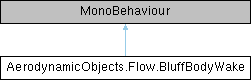
Uses the drag model on an aero object to produce a turbulent wake for the aero object. More...
Public Attributes | |
| float | StrengthMultiplier = 1f |
| The strength of the wake is based on physics so that it is of plausible strength for the body size and speed. More... | |
| float | length = 5 |
| Length of the wake in the downstream direction relative to the size of the body. More... | |
| float | width = 1.0f |
| Starting width of the wake relative to the width of the body. More... | |
| float | StrouhalNumber = 4 |
| The wake vortex shedding frequency is based on a dimensionless physical constant called the Strouhal Number. More... | |
| float | filamentArc = 45 |
| The arc length of filaments at spawn time in degrees. More... | |
| AnimationCurve | strengthOverTime = new AnimationCurve(new Keyframe[] { new(0, 0), new(.1f, 1), new(1, 0) }) |
| Realistic wakes increase in strength just downstream of the body then eventually fade to zero. More... | |
| bool | halfWake |
| Spawn wake for upper half of body only (y local > 0). More... | |
| Transform | parentTransformForWakeObjects |
Detailed Description
Uses the drag model on an aero object to produce a turbulent wake for the aero object.
Must be attached to an object with an AeroObject component and the AeroObject must have the default DragModel enabled.
Member Data Documentation
◆ filamentArc
| float AerodynamicObjects.Flow.BluffBodyWake.filamentArc = 45 |
The arc length of filaments at spawn time in degrees.
Decreasing the arc length reduces the length scale of the turbulence, but increases computational cost for the same strength of wake
◆ halfWake
| bool AerodynamicObjects.Flow.BluffBodyWake.halfWake |
Spawn wake for upper half of body only (y local > 0).
Useful for making more efficient ground vehicle wakes.
◆ length
| float AerodynamicObjects.Flow.BluffBodyWake.length = 5 |
Length of the wake in the downstream direction relative to the size of the body.
Computational cost increases in proportion to wake length. The way in which strength varies over the lenght the length of the wake is controlled by the strength over time curve.
◆ parentTransformForWakeObjects
| Transform AerodynamicObjects.Flow.BluffBodyWake.parentTransformForWakeObjects |
◆ StrengthMultiplier
| float AerodynamicObjects.Flow.BluffBodyWake.StrengthMultiplier = 1f |
The strength of the wake is based on physics so that it is of plausible strength for the body size and speed.
The intensity parameter is a multiplier to this. Default value is 1.
◆ strengthOverTime
| AnimationCurve AerodynamicObjects.Flow.BluffBodyWake.strengthOverTime = new AnimationCurve(new Keyframe[] { new(0, 0), new(.1f, 1), new(1, 0) }) |
Realistic wakes increase in strength just downstream of the body then eventually fade to zero.
The time scale is linked to the wake length so that end point of the curve is the end of the wake.
◆ StrouhalNumber
| float AerodynamicObjects.Flow.BluffBodyWake.StrouhalNumber = 4 |
The wake vortex shedding frequency is based on a dimensionless physical constant called the Strouhal Number.
Higher values mean a faster shedding frequency, and the wake is made up of a greater number of vortex filaments of reduced strength. A lower Strouhal Number means the wake is more lumpy, but at reduced computational cost.
◆ width
| float AerodynamicObjects.Flow.BluffBodyWake.width = 1.0f |
Starting width of the wake relative to the width of the body.
Use higher values for bluff bodies like cubes, values closer to 1 for more streamlined bodies. Can be used to increase the size of the wake for effect.
The documentation for this class was generated from the following file:
- C:/Unity/AO 2/Assets/AO/Scripts/Flow/BluffBodyWake.cs